The Sport
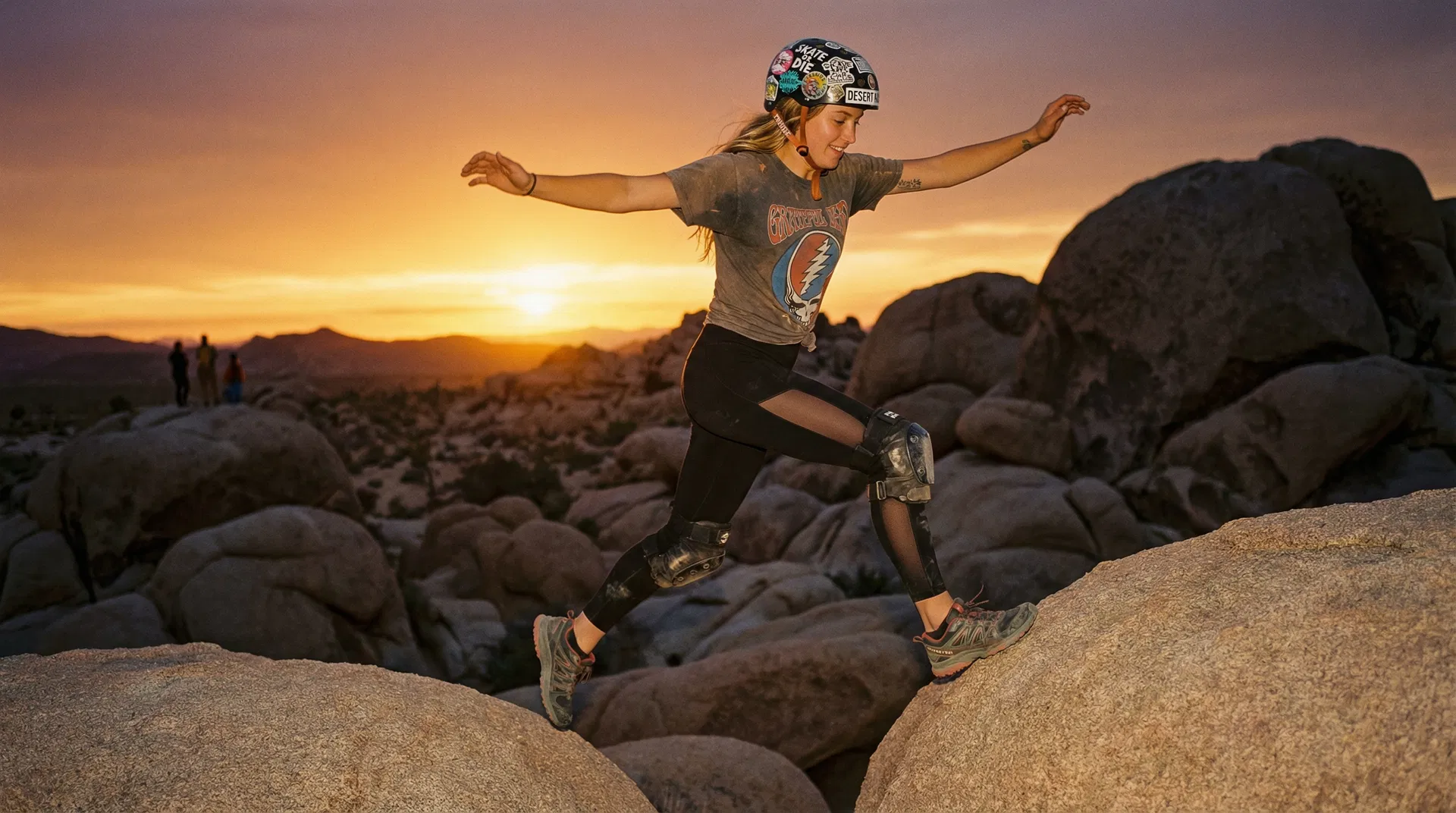
Rally Scrambling is a niche outdoor sport combining the raw, instinctual movement of rock scrambling with the strategic depth of rally racing — and the expressive culture of roller derby and rave.
"Dumb" Flow
Rally Scrambling rejects the intense specialization of other outdoor sports. It's about achieving "dumb" flow — the pure, unadulterated joy of moving through a complex environment quickly and creatively, without overthinking.
"Get from here to there. You'll use all your limbs. The terrain is the puzzle, but there's no single solution. Go as fast as you can. Look sick doing it."
The sport prioritizes accessibility, expression, and the primal fun of full-body movement in nature. It draws from the philosophical roots of 19th-century mountaineering literature and the countercultural spirit of punk and rave.
Where It
Comes From
John Muir
"...tie your mountain shoes firmly over the instep, and with braced nerves run down without any haggling, puttering hesitation, boldly jump from boulder to boulder with ever increasing speed. You will then find your feet playing a tune, and quickly discover the music and poetry of rock piles."
— The Mountains of California
Doug Robinson
"Talus running is the bouldering of the mountaineer... it may yet aspire to the status of an independent sport."
— "Running Talus," Chouinard Equipment Catalog
The modern sport was conceptualized in 2026, formalizing rules, competitive formats, and a unique gear-centric culture that draws from roller derby, cosplay, and motorsports.
The Terrain
is the Puzzle
Boulder Fields
Dense fields of large, irregularly shaped rocks. Requires constant route-finding and full-body engagement. The classic Rally Scrambling terrain.
Talus Slopes
Steep slopes of loose, angular rock debris. Demands balance, quick footwork, and the ability to read which rocks will hold weight.
Rocky Ridges
Exposed ridge lines with mixed terrain. Combines scrambling with route-finding along narrow, sometimes exposed paths.
Two Roles,
One Team
The Scrambler
The athlete physically navigating the course. Speed, agility, creative line-finding, and aesthetic expression all in one. The body is the vehicle.
The driver.
The Line-Caller
The strategist. Performs reconnaissance of the course prior to the event, then provides real-time guidance via helmet-to-helmet radio communication. Technology encouraged: tablets with GPS, AI-powered drone footage analysis.
"Left through the gap, drop two, then send it."
Three
Formats
The Blitz
Mass-start format. Up to 100 competitors launch from a wide starting arc toward a single finish line. Two sub-modes: Free-for-All (individual) and Team (25 teams of 4 Scramblers + 1 Line-Caller). New in v1.2.
Time Trial
The standard format. Competitors or pairs start individually at staggered intervals and race against the clock. Pure you-versus-the-terrain.
Convergence (Grand Prix)
Multi-stage, multi-racer format. Teams start from different points around the perimeter and race toward a single central finish line. Inspired by Mario Kart and Legends of the Hidden Temple.
How You're
Scored
Speed
Primary, objective measure. Fastest time from start to finish across the course.
The clock doesn't lie.
Fit (Aesthetic)
Subjective score based on creativity, cohesiveness, and functional integration of your gear and aesthetic.
How good do you look doing this?
Expression (Style)
Subjective score rewarding creative line choices, acrobatic movements, and overall flow through the terrain.
Did you make it look easy?
"Dumb" (Optional)
Comedic, Taskmaster-style challenge. Judges award points for achieving a bizarre secondary objective during the run.
Can you carry a rubber duck the whole way?
Ready to
Scramble?
Check out the gear classes, find a course near you, or download the full rulebook.